In House Vs Agency. Which Should You Choose To Manage Events


Weekly newsletter
In House vs Agency: What’s Right for Your Event Management?
You’ve just locked in your event budget for the year, and now comes the decision that will shape how it gets spent: Do you build and run everything in-house, hand it off to an agency, or split responsibilities somewhere in between?
Managing events internally means owning supplier sourcing, contracts, logistics, and delivery, often with limited bandwidth and rising pressure to prove ROI. If you’re working with an agency, the expectation is speed and polish, but it often comes with higher costs, less transparency, and reduced control over the details that matter.
According to recent data, 44% of B2B companies manage their marketing in-house, 33% take a hybrid approach, and 21% fully outsource. Each path has implications for cost, control, visibility, and outcome, especially when events represent a major line in your marketing spend.
At Lumix, we’ve worked closely with brands across all three models. We’ve seen where internal teams thrive, where agencies add value, and where both can create unexpected challenges. In this guide, we’ll break down how each approach operates and how to make the right choice for your event goals, budget, and team.
Managing Events In-House: Control, Visibility, and Operational Load
If you’re managing events in-house, you already know what it looks like.
Once the budget is approved and the dates are locked, the real work begins. You start sourcing suppliers, negotiating contracts, managing timelines, and handling logistics. Most team members take on multiple roles. One’s chasing print quotes, another is finalising AV specs, or following up on a delayed payment.
It looks like control, but often feels like firefighting. You’re coordinating with five or more suppliers, each with their terms, lead times, and ways of working.
We’ve seen this play out with in-house teams time and time again. The intent is solid. The experience is there. But the infrastructure usually isn’t. Without dedicated tools built for event delivery, most teams are left stitching things together with spreadsheets, email chains, and general-purpose software that slows them down when they need to move fast.
Pros
- Budget control stays internal, avoiding agency markups and allowing for more precise allocation.
- Supplier choices are fully owned, making it easier to build long-term partnerships and set expectations directly.
- Visibility into individual cost lines, quotes, and payments supports stronger financial reporting.
- Over time, the team builds hands-on experience and institutional knowledge across repeatable formats.
Cons
- Sourcing new suppliers often depends on ad hoc searches or referrals, which slows down planning and risks inconsistent quality.
- Without centralised tools, key workflows like budgeting, approvals, and contracting are fragmented and time-intensive.
- One-off supplier deals mean you’re rarely getting the best rates, and have little leverage for negotiation.
When In-House Event Management Becomes Valuable
An in-house model makes the most sense when your team is focused on repeatable formats, your supplier relationships are stable, and you need more control over cost, branding, or messaging.
But control alone doesn’t guarantee efficiency. It’s important to use the right tools and systems that help you streamline and plan ahead.
With a platform like Lumix supporting your internal setup, you can access a pre-vetted supplier marketplace, automate key workflows, and unlock exclusive pricing typically reserved for large-scale buyers. Instead of stitching together sourcing, contracting, and budget approvals manually. Your team runs smarter, saving time, cutting unnecessary spend, and staying fully in control of delivery.
Partnering with an Agency: Speed, Expertise, and the Trade-Offs
When you hand over event management to an agency, the expectation is clear: they’ll handle the complexity, deliver on time, and make it look effortless. And at face value, that’s exactly what you get. Once the brief is in, the agency builds timelines, brings in their preferred suppliers, manages production, and takes care of day-of logistics. Your team reviews progress, approves budgets, and focuses on the bigger picture.
While agencies are built for scale, they also come with higher fees, less cost transparency, and less control over how things get done behind the scenes. For many companies, that’s acceptable, until budgets tighten or event ROI needs to be defended in front of leadership.
Pros
- Complex logistics, vendor coordination, and execution are taken off your team’s plate.
- Agencies can scale quickly across markets, timelines, and event formats with minimal internal lift.
- You get access to creative talent, production experts, and proven playbooks that would be hard to build in-house.
Cons
- Cost transparency is limited as fees, markups, and bundled charges are often hard to break down.
- Total spend is typically higher due to management overhead and supplier margins.
- You’re tied to the agency’s preferred suppliers, systems, and workflows, which can limit flexibility or slow changes.
When Agency Support Makes Strategic Sense
Working with an agency can be the right call when your team is lean, timelines are short, or you’re planning a high-production event that requires specialist capabilities.
But as budgets come under closer scrutiny, it’s worth reviewing what’s being outsourced and whether the model still makes financial and operational sense.
For teams looking to reduce cost while retaining external expertise, a hybrid approach can offer the best of both: agencies for execution, and platforms like Lumix sitting behind the scenes to bring spend control, supplier visibility, and smarter sourcing into the mix.
The Hidden Cost Equation: What Goes Beyond the Day Rate
A supplier quote or agency fee might seem clear at first, but you can often miss what’s really included, or what it’s actually costing you.
In-house teams carry hidden costs in time and capacity. Hours go into chasing suppliers, managing contracts manually, and stitching together workflows. On the surface, it looks efficient. But the admin burden builds quickly.
Agencies handle planning and logistics, but convenience comes at a cost, usually in the form of supplier markups, hidden rebates, and bundled fees that are difficult to break down.
We’ve seen smart teams overspend simply because they didn’t have the tools to see where the friction and waste were hiding.
Here’s how the cost dynamics are when you’re using either of those:
What Procurement and Finance Really Want to See
Procurement and finance leaders want the event numbers to add up. But in most event setups, what they get is a neatly bundled quote, not the detailed breakdown needed to track ROI, manage risk, or forecast with accuracy.
We’ve seen it across both models. In-house teams juggle multiple vendors with limited central oversight, while agencies often bundle supplier fees, markups, and service charges into a single invoice. In both cases, key questions go unanswered:
- Which suppliers were used, and were they compliant?
- How much was spent on each scope, and was it justified?
- Did the event generate pipeline or reduce the cost per opportunity?
Without clear data, it’s hard to measure the ROI of your event, let alone prove efficiency or compliance. Supplier fragmentation alone can drive 30–40% in avoidable spend. And with ESG reporting and contract audits becoming more common, working with unvetted or last-minute vendors adds real risk.
The Lumix team understands these technicalities and brings the structure needed to align event delivery with procurement expectations. We centralise payments, streamline proposals and contracts, and give real-time visibility into spend.
That means you can track costs at a granular level, work only with ESG-compliant, pre-vetted suppliers, and avoid financial or legal surprises. Most importantly, your ROI reporting is grounded in clear, defensible numbers, ready for procurement, finance, or the board.
Choosing Your Approach to Event Management
The right model depends on your structure, capacity, and where the pressure points are. Here are three common scenarios and how to think through them:
Scenario 1: You’re Already Working with an Agency
You’ve outsourced event delivery, but questions are surfacing around cost, control, and transparency.
- Review where markups are being added and how they impact your total spend
- Look at the supplier overlap and identify the same services being re-billed across events.
- Are you getting clear, line-item visibility into how budgets are used?
In some cases, teams retain their agency for creative and execution but start sourcing suppliers directly to gain more control over cost and performance.
Scenario 2: You’re Managing In-House and Bandwidth Is Tight
You’ve kept delivery internal, but the administrative burden is growing.
- Map where time is going, such as supplier research, contracting, and budget approvals
- Identify workflow gaps, including disconnected systems often slow things down
- Ask if internal focus is shifting too far from strategy into day-to-day firefighting
For repeatable formats, an in-house team can work well, especially when supported by tech that removes the manual overhead.
Scenario 3: You’re Reviewing Both Paths
You’re starting fresh or rethinking your current approach. Use a scorecard to weigh each model across five factors:
- Cost transparency – Can you see where every pound is going?
- Supplier control – Who decides which vendors get used?
- Operational speed – How quickly can your team execute under pressure?
- Strategic alignment – Are events clearly tied to brand and business goals?
- Budget ownership – Who’s accountable for spend and outcomes?
This helps you spot where a hybrid model might make sense, combining internal leadership with the right external support and smarter systems behind the scenes.
Is there a right answer?
Choosing between in-house delivery and agency support comes down to what your team needs most: control, speed, or a balance of both. Each model has its strengths, but the real advantage comes from visibility, efficiency, and knowing where your budget is going.
Lumix helps bring that clarity. We streamline sourcing, cut out hidden costs, and give your team the tools to manage suppliers and spend, no matter which model you run.
Book a demo and discover how Lumix supports smarter event delivery, in-house or with your agency.
Lumix Blogs
Get the indise scoop: the latest tips, tricks, & product updates
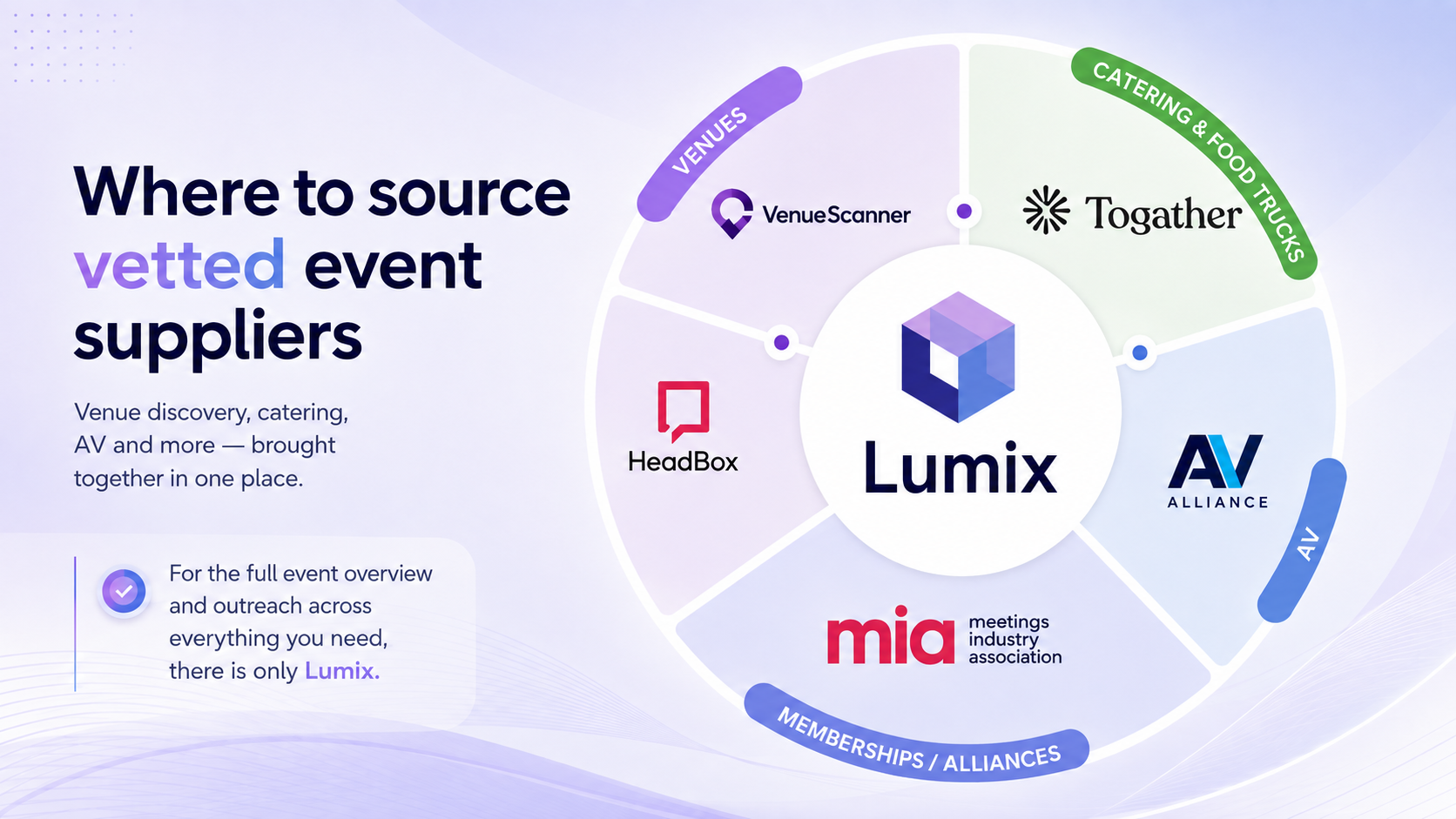
How to Choose a Vetted Event Supplier Network in 2026
Corporate event procurement in the UK increasingly runs through vetted vendor networks and specialist marketplaces rather than cold outreach, but the right choice depends on how many categories a brief actually spans.
Cvent vs Vetted Event Supplier Networks: A Procurement Comparison for UK Teams
Choosing between broad event supplier platforms and vetted networks shapes how much risk and cost control a procurement team actually has once a brief goes out.
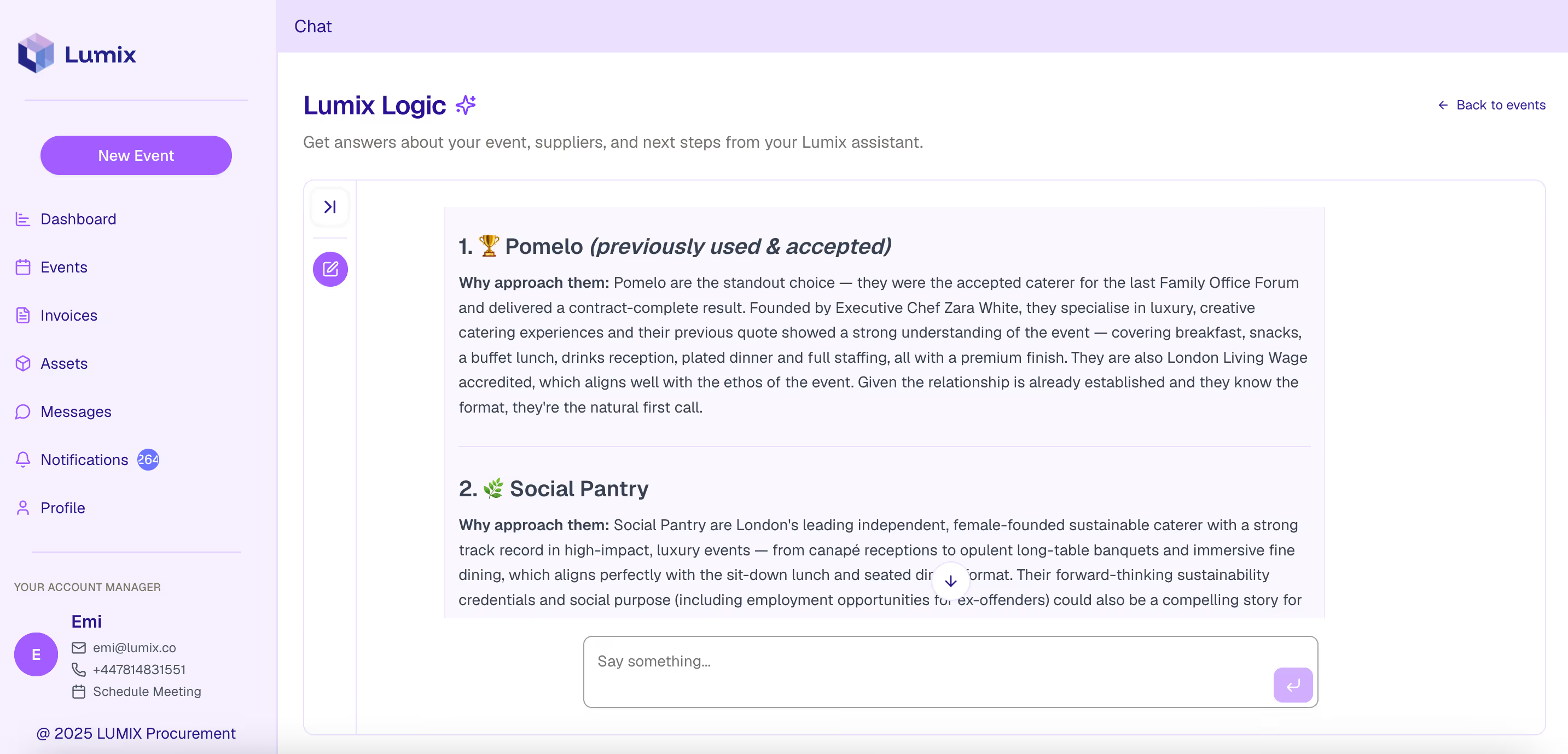
Lumix Logic: The AI Agent That Changes Everything About Event Planning
Lumix Logic is live. Here's why it's the biggest shift in event planning technology in years — and what it means for your team.
Frequently Asked Question
Have another question? Please contact our team!
Yes. The platform provides side-by-side quote comparisons that show what’s included (and what isn’t) in each proposal. You’ll see cost breakdowns, supplier notes, and Lumix’s benchmarked pricing insights all designed to help you make confident, data-driven decisions.
Yes. You can upload and store your existing brief templates, or use Lumix’s AI-assisted builder to generate new ones. The platform also learns from your past events, so future briefs can be created faster with pre-filled details and preferred suppliers.
Absolutely. Lumix is built for flexibility. You can update or amend briefs at any time through quote revisions. When you make changes, suppliers are automatically notified and can adjust their quotes accordingly, keeping everything transparent and version-controlled.
A Lumix-vetted supplier has been verified for legal identity, financial health, insurance, certifications, and recent performance. We don’t just check paperwork once — we continuously monitor suppliers’ live performance on the platform to ensure they meet professional, safety, and compliance standards.
Our vetting process happens in three levels: Verified: Baseline identity and compliance checks, legal registration, sanctions screening, insurance, and minimum financial health scores. Certified: Category-specific evidence such as food-hygiene, rigging, or data-security certifications, depending on the supplier’s role. Audited: For high-value or critical suppliers, we add deeper due diligence including third-party audits, ESG assessment, and verified delivery KPIs on Lumix.
Yes. We align our vetting standards with leading UK and global frameworks such as Achilles, Hellios FSQS/JOSCAR, Avetta, SafeContractor, and EcoVadis. Where appropriate, Lumix integrates or recognises these certifications within our supplier profiles to avoid duplicate checks.