How to Budget Effectively for Your Next Event (Guide + CFO Buy‑In Tips)

.avif)
Weekly newsletter
In this practical guide, we’ll explore the key requirements for effectively setting a budget for your next event and tackle the most important question - how do you actually get buy in and sign off from your friends in finance.
In this article we’ll link to a number of downloadable templates to help you with your next event.
Why Is an Event Budget Important?
An event budget is not just an accounting nice-to-have, it’s the operating system for your event. Done well, it translates creative ambition into a plan that finance can back and your team can execute.
A clear budget prioritises outcomes by forcing you to articulate what the event must achieve be it pipeline created, accounts reached, renewals protected, brand awareness gained, community supported - before you fall in love with stage renders or menu tastings. When your budget starts with business outcomes, every pound you allocate is tethered to a measurable result rather than a nice‑to‑have.
A good budget also creates explicit trade‑offs you can defend. If you decide to invest more in a hero demo and cut back on printed signage, you can explain that choice in terms of expected conversion or sponsor value, not design preference. This is what finance teams look for: a rationale that links spend to outcomes, plus a list of what you’ve consciously not funded.
Crucially, budgeting surfaces risk early. Minimum guarantees, cancellation windows, drayage, overtime rules - these are rarely glamorous, but they are where projects overspend. Writing these into the budget (with dates, thresholds, and owners) means you’re managing risk on purpose, not discovering it on site. Pair that with cash‑flow awareness, when deposits hit, what’s due post‑event - and you avoid nasty surprises in that conversation with finance.
Finally, a disciplined budget enables iteration across your event program. Because you’ve captured unit economics (cost per qualified attendee, cost per lead, payback), you can compare events fairly, learn what scales, and redirect spend with confidence. The output isn’t “we kept to budget,” it’s “we improved economics and learned where the next pound does the most damage.”
A quick example: Instead of “£80k conference,” frame it as “£80k to reach 250 ICP buyers, book 40 meetings, and generate £1.2m pipeline in 60 days. If registrations lag 20%, we downscale F&B and cancel the overflow room to protect margin.” That’s a budget finance can say yes to.
Event Budgeting Guide: A Step‑by‑Step Framework
Before now we’ve spoken about the event planning pyramid - a framework to help execute an event with the outcomes you want. An event budget sits within the foundational layer of an event - Feasibility & Control - so below we’ve put together a step-by-step approach to help you budget your next event
1) Define Outcomes & Guardrails
- Primary objective: (e.g., 120 target accounts in-room; 35 SQLs within 30 days; 2 partner deals).
- Financial guardrails: max cash exposure, break‑even rules, contingency %.
- Success metrics: e.g., cost per attendee, cost per lead (CPL), post‑event conversion milestones.
2) Build a Simple Revenue/Value Model
- Direct revenue: tickets, sponsorships, exhibitor fees.
- Indirect value: pipeline value from meetings, retention lift, expansion opportunities.
- Three scenarios: conservative / likely / stretch with different attendance + sponsor uptake.
Quick Formula Box
Gross Margin = (Revenue – Direct Event Costs) / RevenueCPL = Total Event Cost / # Qualified LeadsPayback = Total Event Cost / 12‑mo Contribution Margin from Event‑sourced Deals
3) Allocate Costs by Category
Use ranges so you can flex as quotes land. Typical allocation across popular suppliers looks as follows:
We’ve also put together the event budgeting framework that you can access by downloading here
4) Model Unit Economics (Per‑Attendee)
Modelling the cost of each attendee can help you create a sliding scale of anticipated costs as you potentially discuss variables like venue size, attendee count and more. Here’s the simple calculation:
- Cost per attendee = (Total Variable Costs ÷ Expected Attendance) + (Fixed Costs ÷ Expected Attendance).
- Track by scenario. This prevents nasty surprises if registrations undershoot.
5) Stress‑Test with Scenarios
- Conservative: 60–70% of target attendance; low sponsor uptake.
- Likely: 90–100% of target; planned sponsor mix.
- Stretch: 110–130% of target; extra sponsor slots / upsells. Pair each with a go/no‑go gate and cut/add list.
6) Lock the Commercials (Contracts & Risk)
- Cancellation windows, force majeure, deposits, attrition.
- Supplier contingency (backup AV provider, spare crew, rental options).
- Single‑contract consolidation where possible (reduces admin + leakage).
7) Build the Tracking Cadence
- Pre‑event: weekly burn chart vs. budget; red/amber/green per category.
- During: daily cost log (changes, overtime, damage, add‑ons).
- Post‑event: 7‑, 30‑, 60‑day ROI snapshots.
How Much Should My Event Budget Be?
There’s no universal percentage to copy. The practical way to answer this is to work backwards from goals and audience quality, then test affordability with scenarios. Start by defining the commercial target (e.g., “40 qualified meetings with mid‑market ops leaders” or “£600k pipeline from existing accounts”). Estimate how many right‑fit people you need in the room to hit that outcome, then price the experience required to attract them (venue, content, production, hospitality). If the resulting cost per qualified conversation or pipeline‑to‑cost ratio looks unhealthy, reduce scope or shift format before you book anything.
To anchor expectations, here are starting ranges you can tune with quotes and vendor rates:
Executive roundtable (30–60 pax): £8k–£25k. Costs swing on venue class and F&B sophistication; production is minimal.
Single‑track conference (150–300 pax): £60k–£180k. The big levers are catering minimums and AV/stage build; negotiate attrition hard.
Tradeshow pavilion/activation: £25k–£120k. Footprint and booth type (portable → custom) determine most of the variance.
Field marketing roadshow (3–6 stops): £45k–£150k + travel. Standardising the kit and menu trims per‑stop cost.
Sanity test with scenarios: model conservative (70% attendance, low sponsor uptake), likely (100%), and stretch (120% + upsells). Attach a go/no‑go gate to each. If the conservative case still delivers acceptable unit economics, you’re in safe territory; if not, adjust scope until it does. Then lock contracts accordingly (deposits, cancellation windows, attrition) so your downside is genuinely capped.
20 Top Tips To Win Over The CFO To Invest In An Event
You can have the most compelling event concept in the world - the right audience, a strong theme, even early interest - and still hit a hard stop at one place: the CFO’s desk.
For finance leaders, events aren’t judged on vibes, creativity or how full the room feels on the day. They’re assessed like any other investment - cost, risk and return. And if your proposal doesn’t speak that language, it’s unlikely to get the green light, no matter how good the idea is.
The good news? Winning over your CFO doesn’t mean stripping the soul out of your event. It means framing it differently. As Lumix CMO, Mark Phibbs, puts it, “If you speak the CFO’s language you’ll get much more out of them. They become strategic partners rather than people checking you’re spending correctly”.
This article breaks down 20 practical, CFO-friendly tips to help you build a stronger investment case for the events you’re planning. Whatever you’re organising, these tips will help you move the conversation away from “Can we afford this?” and towards “What happens if we don’t?” and you can download these tips so they’re to hand at any point here.
1. Get ahead of the ask
Be proactive in bringing your proposal to the CFO - don’t wait for them to ask, get them involved from the planning stages.
2. Tie timing to budget cycles and forecasting
Demonstrate awareness of financial calendars, cash flow and quarterly pressure points.
3.Know what your ‘tada’ moment is
Present the key strategic imperative of running the event and what impact that will have on business from brand and/or revenue point of view.
4. Lead with KPIs, not the vision
Open with why the event exists in business terms (revenue, pipeline, retention, brand equity), not what it will look like.
5. Use external validation
Reference competitors, industry norms or partner demand to reduce perceived risk.
6. Demonstrate audience quality, not just size
Who is attending is often more important than how many.
7. Compare event spend to other marketing channels
Frame the event as one option in the marketing strategy and show how it stacks up against other channels such as paid media, sponsorship or sales outreach.
8. Benchmark against past events
If you’ve run events before, show historical cost per lead, cost per attendee, or revenue impact.
9. Speak in ranges, not certainties
CFOs don’t expect certainty, they appreciate realism. Present conservative, likely and stretch scenarios.
10 Quantify the cost of not running the event
Missed pipeline, stagnant community growth or lost partner opportunities are real costs too.
11. Connect the event with long-term customer value
Show how the event contributes to retention, expansion or lifetime value, not just acquisition.
12. Look past the event
Map how leads, partnerships, renewals or community momentum will be converted post-event.
13. Show how success will be measured (and reported)
Outline exactly what data will be captured and when results will be shared post-event.
14. Bring risk mitigation into the conversation early
Show you’re prepared by covering cancellation policies, insurance, minimum attendee thresholds and supplier contingencies up front.
15. Show where spend is scalable
Highlight which elements can grow or shrink based on ticket sales, sponsorship uptake or early indicators.
16. Separate “must-haves” from “nice-to-haves”
Make it clear what delivers core value and what could be cut if the budget tightens. Be flexible.
17. Show what you’ve already negotiated
Even small wins like venue discounts or sponsor contributions show financial discipline.
18. Be explicit about accountability
Make it clear who owns the budget, who signs off changes, and how overspend will be controlled. This builds trust fast with finance teams.
19. Make it easy to say yes
Present a clear recommendation and defined scope, not an open-ended discussion.
20. Involve the CFO in the event
We’ve worked with ex Adobe CMO Mark Phibbs a lot and he recommends you “get the CFO to present at the event talking on a topic targeting CFOs. There’s nothing better than getting a CFO engaged and involved in an event for them to fully understand what the value is.”
At its core, winning CFO buy-in isn’t about fighting for budget, it’s about building trust. When you approach event investment with commercial clarity, financial discipline and a clear plan for impact, you move the conversation out of the realm of “nice to have” and into strategic decision-making. The strongest event proposals don’t ask finance teams to take a leap of faith - they give them a well-reasoned case to stand behind. Get that right, and your events won’t just get approved, they’ll become a valued part of how the business grows.
Templates & Next Steps
Download: We've linked to our event budget template and 20 tips to win over the CFO above, but you can also get started with our event planning template here too. Keep these to hand when planning your next event.
Coming soon: Tradeshow Booth Cost Calculator (portable/modular/custom; transport, setup, storage).
Talk to us: Want a quick Supplier Cost Review or contract sanity check? We’ll benchmark quotes and flag risk.
Lumix Blogs
Get the indise scoop: the latest tips, tricks, & product updates
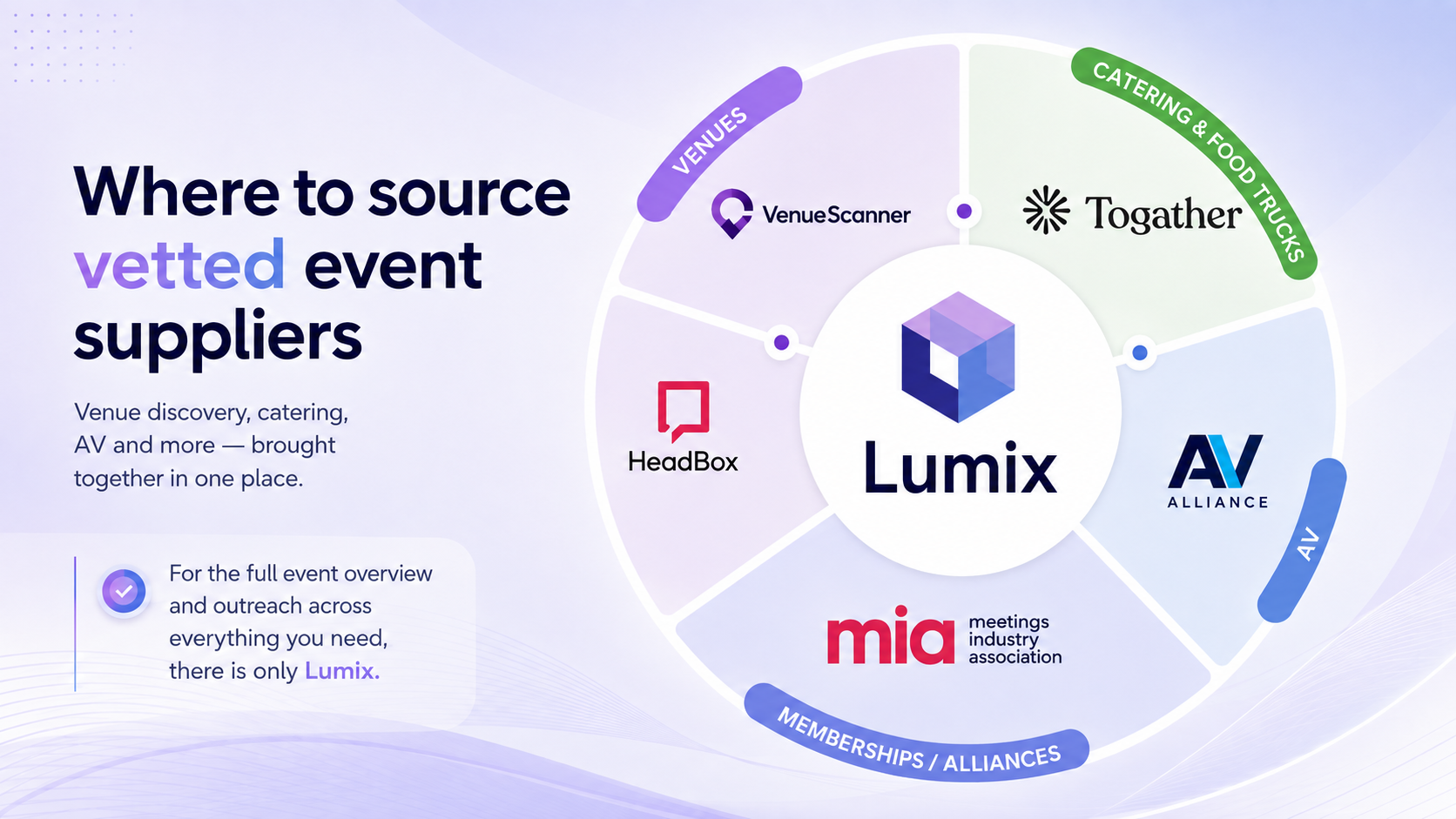
How to Choose a Vetted Event Supplier Network in 2026
Corporate event procurement in the UK increasingly runs through vetted vendor networks and specialist marketplaces rather than cold outreach, but the right choice depends on how many categories a brief actually spans.
Cvent vs Vetted Event Supplier Networks: A Procurement Comparison for UK Teams
Choosing between broad event supplier platforms and vetted networks shapes how much risk and cost control a procurement team actually has once a brief goes out.
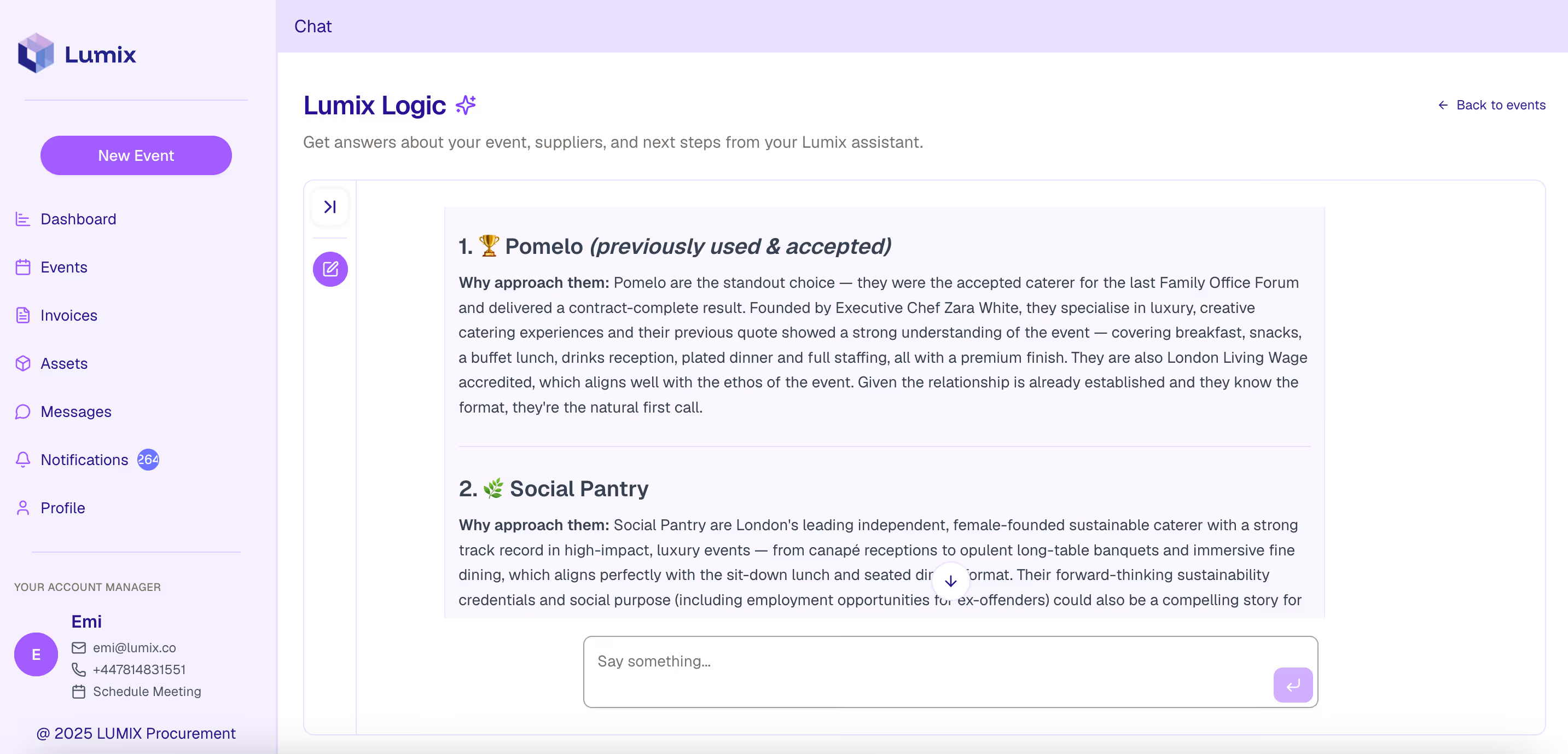
Lumix Logic: The AI Agent That Changes Everything About Event Planning
Lumix Logic is live. Here's why it's the biggest shift in event planning technology in years — and what it means for your team.
Frequently Asked Question
Have another question? Please contact our team!
Yes. The platform provides side-by-side quote comparisons that show what’s included (and what isn’t) in each proposal. You’ll see cost breakdowns, supplier notes, and Lumix’s benchmarked pricing insights all designed to help you make confident, data-driven decisions.
Yes. You can upload and store your existing brief templates, or use Lumix’s AI-assisted builder to generate new ones. The platform also learns from your past events, so future briefs can be created faster with pre-filled details and preferred suppliers.
Absolutely. Lumix is built for flexibility. You can update or amend briefs at any time through quote revisions. When you make changes, suppliers are automatically notified and can adjust their quotes accordingly, keeping everything transparent and version-controlled.
A Lumix-vetted supplier has been verified for legal identity, financial health, insurance, certifications, and recent performance. We don’t just check paperwork once — we continuously monitor suppliers’ live performance on the platform to ensure they meet professional, safety, and compliance standards.
Our vetting process happens in three levels: Verified: Baseline identity and compliance checks, legal registration, sanctions screening, insurance, and minimum financial health scores. Certified: Category-specific evidence such as food-hygiene, rigging, or data-security certifications, depending on the supplier’s role. Audited: For high-value or critical suppliers, we add deeper due diligence including third-party audits, ESG assessment, and verified delivery KPIs on Lumix.
Yes. We align our vetting standards with leading UK and global frameworks such as Achilles, Hellios FSQS/JOSCAR, Avetta, SafeContractor, and EcoVadis. Where appropriate, Lumix integrates or recognises these certifications within our supplier profiles to avoid duplicate checks.