How to Find and Secure Sponsors for an Event (A Practical Guide for Event Organisers)

.avif)
Weekly newsletter
Finding sponsors for an event can feel like a guessing game. You know sponsorship is possible because you see other events doing it, but when it comes to working out who to approach, what to offer and how to secure a yes, the process often feels more like guesswork than strategy.
The reality is that successful event sponsorship isn’t about luck. It’s about alignment. When your audience, your event format and a sponsor’s commercial goals line up, sponsorship becomes a straightforward business decision rather than you feeling like you’re asking for a favour.
In this guide, we’ll walk through exactly how to find sponsors for an event, how to attract the right brands, and how to secure sponsorship in a way that’s repeatable and sustainable.
What event sponsors are actually looking for
Before you start approaching potential sponsors, it’s important to understand how they think. Sponsors don’t invest in events because they like the idea, they invest because the event helps them achieve a specific outcome. You scratch their back, they’ll scratch yours.
Most event sponsors are looking for one (or more) of the following:
- Access to a clearly defined audience that aligns with their own
- Brand visibility in a relevant context
- Lead generation or pipeline opportunities
- Credibility through association
- Direct customer engagement
If you can clearly articulate how your event delivers on these outcomes, you’ll find it far easier to attract sponsors, and to command stronger sponsorship value.
How to find sponsors for an event
When people ask “how do you get sponsors for an event?”, the assumption is often that you need to pick up the phone and start cold-pitching random companies. In reality, the best sponsors are usually much closer than you think. Our top tips for finding sponsors are:
- Start with brands already connected to your audience
Look at the products, services and tools your attendees already use. These companies already value your audience and your event simply gives them a focused way to reach them.
- Review sponsors of similar events
If a brand is already sponsoring events similar to yours, they’ve proven budget and intent. This makes them far easier to approach.
- Look at your existing partners and suppliers
Venues, platforms, agencies and service providers often sponsor events as part of their marketing strategy, especially if there’s a clear audience fit.
- Don’t overlook internal connections
Warm introductions dramatically increase response rates. Sales teams, leadership and partners may already have relationships you can leverage. Finding sponsors isn’t about volume - it’s about relevance, so use those connections to your advantage.
How to make your proposition compelling
Attracting sponsors for an event requires shifting the focus away from your needs and towards theirs.
Instead of leading with:
- “We’re looking for sponsors”
- “Here are our packages”
- “This will help us cover costs”
Lead with:
- Who your audience is
- Why that audience matters to them
- How sponsors can engage meaningfully with them
The strongest sponsorship propositions are:
- Outcome-led, not asset-led
- Specific, not generic
- Designed around engagement, not exposure
Think beyond just logos and ask: What experience or access would genuinely be valuable to a sponsor’s business?
How to create sponsorship packages that sell
If you want to obtain sponsors for an event consistently, your sponsorship packages need to be easy to understand and make commercial sense.
Effective sponsorship packages:
- Are structured around outcomes
- Reflect genuine value differences between tiers
- Avoid padding with low-impact deliverables
- Feel flexible, not restrictive
Rather than offering multiple variations of the same thing, build packages that align with different sponsor goals such as brand visibility, lead generation or thought leadership.
Many sponsorship packages fail not because the event lacks value, but because the value isn’t clearly articulated.
Strong sponsorship packages are built around outcomes, not assets. To illustrate this, here’s a simplified example of how an event organiser might structure packages for a mid-sized B2B event.
Example: Sponsorship package breakdown
Gold Sponsor – £15,000
Designed for sponsors seeking visibility and direct engagement.
Includes:
- Exclusive sponsorship of a keynote session
- Speaking opportunity (panel chat)
- Access to opt-in attendee data post-event
- Brand placement across event website, emails and signage
- Dedicated networking time with attendees
Why this works:
The sponsor gains authority, visibility and lead generation — not just logo placement.
Silver Sponsor – £7,500
Designed for sponsors focused on brand presence and targeted exposure.
Includes:
- Sponsorship of a breakout session or workshop
- Brand placement across key event touchpoints
- On-site presence (stand or activation space)
Why this works:
This tier balances cost with meaningful exposure, without overstretching delivery.
Bronze Sponsor – £3,000
Designed for emerging brands or partners aligned with the audience.
Includes:
- Brand inclusion on event materials
- Mention in opening or closing remarks
- Social media and email visibility
Why this works:
Lower commitment, but still tied to relevance and credibility.
The key takeaway isn’t the pricing, it’s the structure. Each package serves a different sponsor objective and feels intentional, not padded. When sponsors can clearly see how a package supports their goals, securing sponsorship becomes far easier.
Different types of event sponsorship (and when they make sense)
Not all event sponsorship looks the same, and choosing the wrong model can make sponsorship harder to sell than it needs to be. Understanding the different types of event sponsorship helps you match the right opportunity to the right sponsor, rather than forcing every brand into the same package.
Below are some of the most common sponsorship types, and when they tend to work best.
- Brand sponsorship
This is the most familiar form of event sponsorship, where a sponsor gains brand visibility across event touchpoints such as signage, programmes, websites or emails.
Best suited for:
- Large-scale events with strong reach
- Sponsors focused on awareness rather than direct leads
- Events with strong brand credibility or media exposure
Brand sponsorship works best when the audience is highly relevant. Visibility alone rarely justifies investment unless the context is right.
- Content or thought leadership sponsorship
In this model, sponsors are aligned with content, such as keynote sessions, panels, workshops or reports, positioning them as experts rather than advertisers.
Best suited for:
- B2B or professional audiences
- Community or education-led events
Sponsors looking to build credibility and trust
This type of sponsorship often delivers more long-term value than logo placement, especially for complex or high-consideration products.
- Lead generation sponsorship
Here, the sponsor’s primary goal is access, whether that’s attendee data, meetings, demos or opt-ins.
Best suited for:
- Revenue-driven events
- Sponsors with clear sales teams and follow-up processes
- Events with well-defined attendee profiles
Lead generation sponsorship requires clear boundaries and transparency around data usage to maintain trust with attendees.
- Experiential or activation sponsorship
These sponsors engage attendees through interactive experiences - product demos, lounges, installations or hands-on activities.
Best suited for:
- Events with strong in-person engagement
- Brands with tangible products or services
- Sponsors looking to create memorable moments
This works particularly well when the activation feels like it’s adding something to the event experience, not disruptive to it.
- Category-exclusive sponsorship
Some sponsors value exclusivity over scale. Category exclusivity ensures no direct competitors appear alongside them.
Best suited for:
- Competitive industries
- High-value sponsors
- Smaller events with tightly defined audiences
Exclusivity can significantly increase sponsorship value when paired with clear relevance.
By understanding these different models, you can shape sponsorship opportunities around sponsor goals rather than defaulting to one-size-fits-all packages.
How to approach sponsors (and actually get a response)
One of the biggest blockers to securing event sponsorship is outreach that feels vague or generic.
When approaching potential sponsors:
- Personalise every message
- Clearly explain why they’re a good fit for your event (and why your event is a good fit for them)
- Focus on relevance over reach
- Keep initial outreach short and conversational
- Avoid sending long decks upfront. The goal of your first message is simple: start a conversation.
This approach is far more effective than trying to “sell” sponsorship in the first interaction.
Common mistakes event organisers make with sponsorship
Even well-planned events can struggle to secure sponsors if a few common mistakes creep in. Being aware of these upfront can save time, protect relationships and significantly improve your chances of success.
- Treating sponsorship as cost recovery
One of the biggest mistakes is positioning sponsorship as a way to plug a gap in your budget. Sponsors aren’t there to fund your event, they’re investing to achieve their own commercial goals. When sponsorship is framed around covering costs rather than delivering value, it becomes much harder to justify the investment. -
- Leading with logos instead of outcomes
Many sponsorship proposals focus heavily on logo placement and brand exposure, without explaining why those placements matter. As we’ve already covered, logos alone rarely move the needle. Sponsors want to understand how their involvement will translate into awareness, engagement, leads or credibility. -
- Sending generic sponsorship decks
Reusing the same sponsorship deck for every potential partner is a fast way to lose interest. Generic decks signal low effort and poor alignment. Even small personalisation e.g. referencing a sponsor’s audience, product or recent activity can dramatically increase response rates. Show them this isn’t just a scatter-gun approach. -
- Approaching sponsors too late
Leaving sponsorship conversations until plans are finalised limits value, budget and your flexibility. Sponsors are far more likely to commit when they can shape the opportunity and feel involved, rather than being presented with a take-it-or-leave-it package. -
- Overpromising and underdelivering
Overselling benefits in order to close a deal can damage long-term relationships. Missed deliverables or unclear reporting erode trust quickly. It’s far better to promise honestly and deliver well than to secure a one-off sponsor you can’t retain because you promised something you already knew you’d never be able to deliver. -
Avoiding these pitfalls won’t just help you secure sponsorship more easily, it will also lay all-important groundwork for stronger, longer-term partnerships.
How to retain sponsors for future events
The real value of event sponsorship comes from retention, not one-off deals.
After the event:
- Share performance data promptly
- Report honestly on outcomes - this is a relationship built on trust
- Highlight qualitative wins as well as metrics
- Start conversations about future opportunities early
When sponsors feel informed, valued and involved, repeat sponsorship becomes the default rather than the exception.
Final thoughts
Learning how to find and secure sponsors for an event isn’t about perfect pitches or flashy decks. It’s about understanding commercial alignment, building trust and treating sponsorship as a partnership, not a transaction.
Get those fundamentals right, and sponsorship stops being a stressful scramble and starts becoming a reliable, scalable part of your event strategy.
8 Quick Tips To Secure Event Sponsorship
Successful event sponsorship isn’t about sending more emails or offering bigger logo placements. It’s about understanding what sponsors actually value, aligning that with the audience you’re bringing together, and presenting the opportunity in a way that makes commercial sense.
Here, we’ve broken down 8 practical tips to help you find, attract and secure event sponsorship, no matter what event you’re planning. Each tip is designed to be actionable, so you can move from “we should get sponsors” to “we know exactly how to approach this”.
1. Start with sponsor outcomes, not your event
Sponsors care about leads, visibility, credibility or access - not your agenda. Be clear on what they get out of it first.
2. Know exactly who your audience is (and why it matters to your sponsors)
The clearer you are on attendee profile, seniority and buying power, the easier it is for sponsors to see the value.
3. Build sponsorship around real touchpoints
Think beyond logos dotted around your event. Content slots, data access, networking moments and product experiences are often more valuable to sponsors.
4. Create tiers that make sense commercially
Packages should reflect value, not just price points. Avoid forcing sponsors into options that don’t fit their goals.
5. Price based on impact, not cost recovery
Strong sponsorship is sold on outcomes and reach, not how much you need to cover your budget.
6. Make sponsorship feel limited
Scarcity drives decisions. Exclusive categories, capped numbers or first-mover benefits all increase urgency.
7. Use warm introductions wherever possible
Sponsors are far more likely to say yes when approached through existing relationships or mutual connections.
8. Sell early, before everything is final
Sponsors often want to shape the event, not just bolt on at the end. Early conversations unlock bigger deals.
Event sponsorship works best when it’s treated as a long-term strategy, not a one-off win. Focus on alignment, deliver on what you promise, and build relationships that extend beyond a single event, and securing sponsors becomes far easier every time you do it.
Lumix Blogs
Get the indise scoop: the latest tips, tricks, & product updates
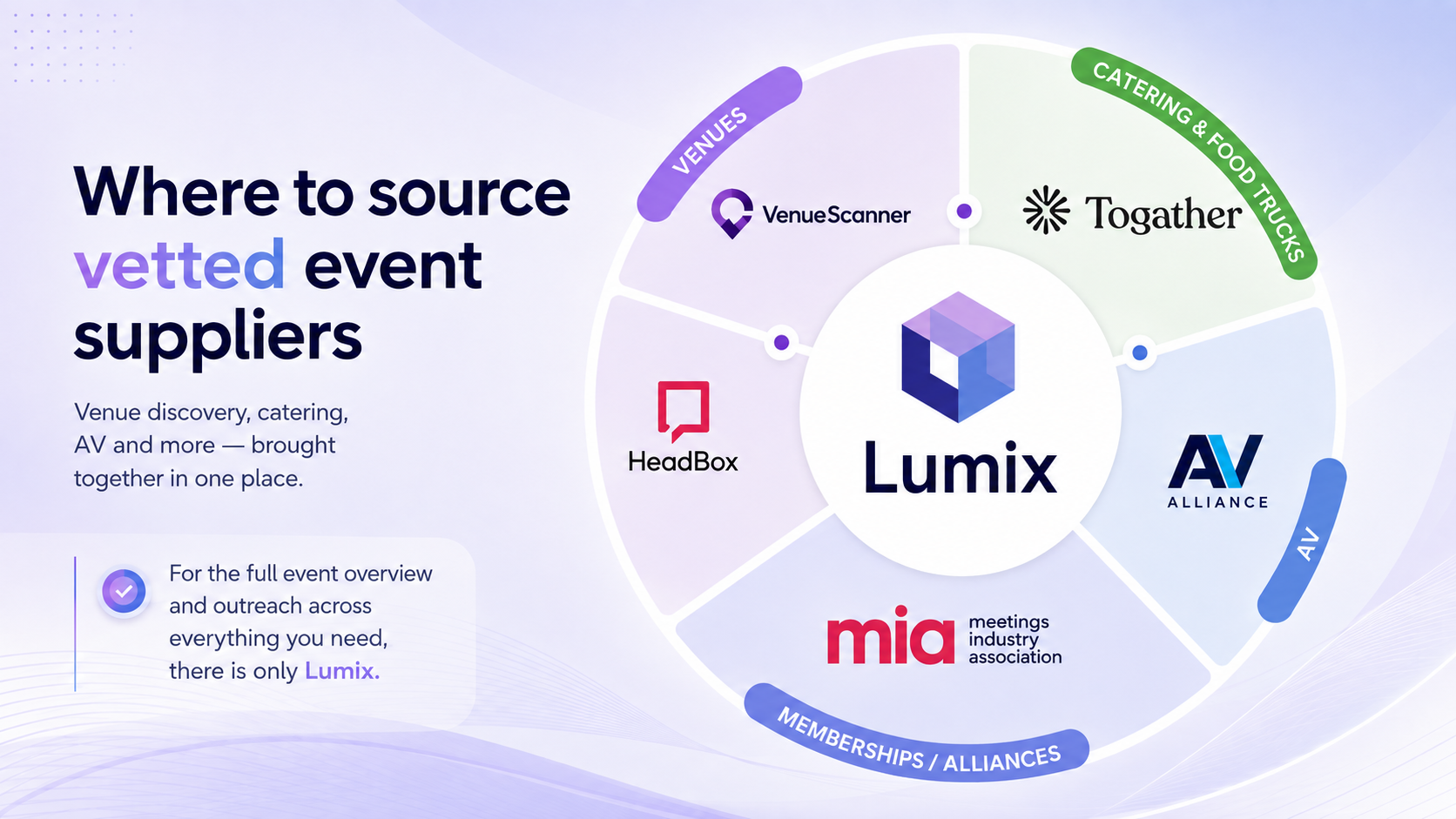
How to Choose a Vetted Event Supplier Network in 2026
Corporate event procurement in the UK increasingly runs through vetted vendor networks and specialist marketplaces rather than cold outreach, but the right choice depends on how many categories a brief actually spans.
Cvent vs Vetted Event Supplier Networks: A Procurement Comparison for UK Teams
Choosing between broad event supplier platforms and vetted networks shapes how much risk and cost control a procurement team actually has once a brief goes out.
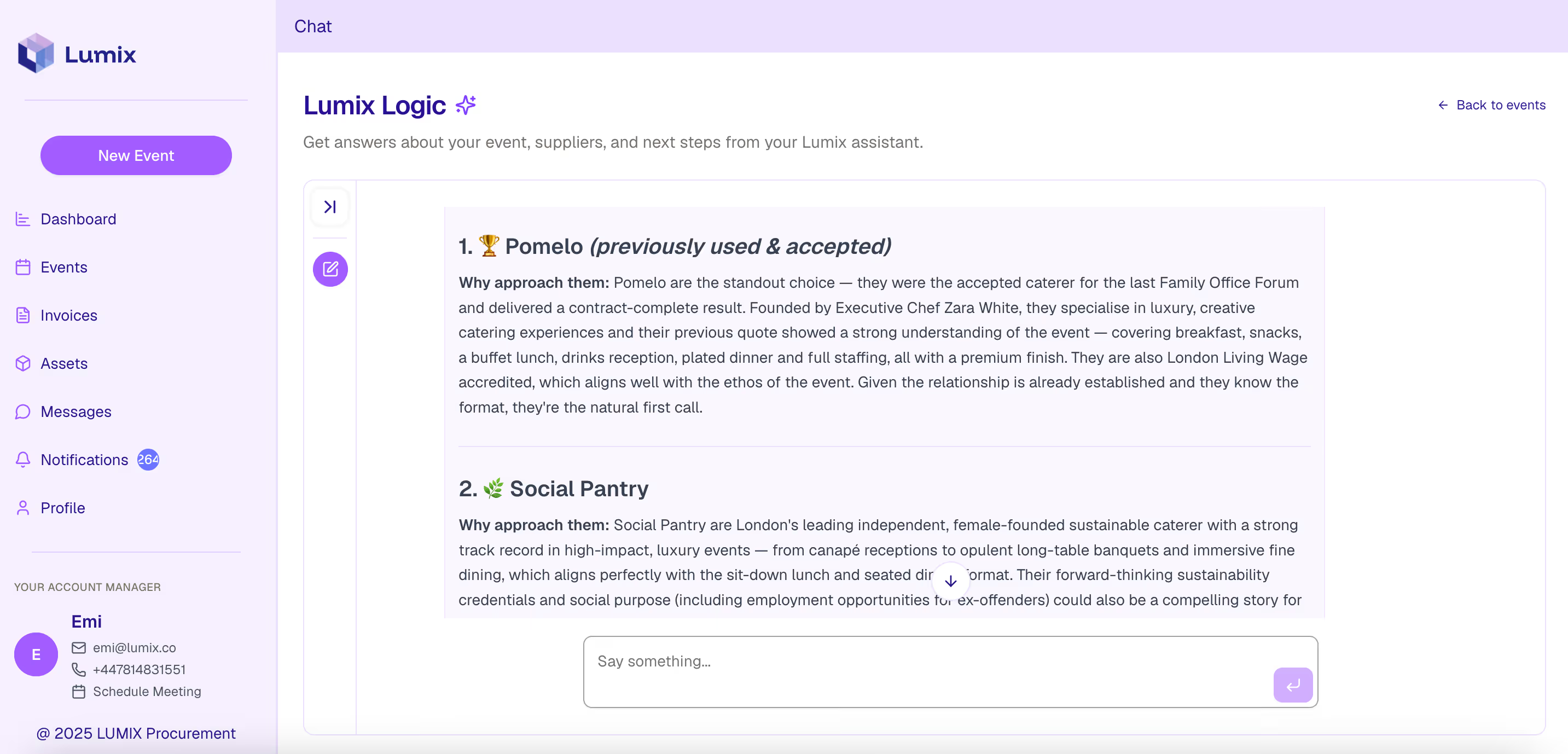
Lumix Logic: The AI Agent That Changes Everything About Event Planning
Lumix Logic is live. Here's why it's the biggest shift in event planning technology in years — and what it means for your team.
Frequently Asked Question
Have another question? Please contact our team!
Yes. The platform provides side-by-side quote comparisons that show what’s included (and what isn’t) in each proposal. You’ll see cost breakdowns, supplier notes, and Lumix’s benchmarked pricing insights all designed to help you make confident, data-driven decisions.
Yes. You can upload and store your existing brief templates, or use Lumix’s AI-assisted builder to generate new ones. The platform also learns from your past events, so future briefs can be created faster with pre-filled details and preferred suppliers.
Absolutely. Lumix is built for flexibility. You can update or amend briefs at any time through quote revisions. When you make changes, suppliers are automatically notified and can adjust their quotes accordingly, keeping everything transparent and version-controlled.
A Lumix-vetted supplier has been verified for legal identity, financial health, insurance, certifications, and recent performance. We don’t just check paperwork once — we continuously monitor suppliers’ live performance on the platform to ensure they meet professional, safety, and compliance standards.
Our vetting process happens in three levels: Verified: Baseline identity and compliance checks, legal registration, sanctions screening, insurance, and minimum financial health scores. Certified: Category-specific evidence such as food-hygiene, rigging, or data-security certifications, depending on the supplier’s role. Audited: For high-value or critical suppliers, we add deeper due diligence including third-party audits, ESG assessment, and verified delivery KPIs on Lumix.
Yes. We align our vetting standards with leading UK and global frameworks such as Achilles, Hellios FSQS/JOSCAR, Avetta, SafeContractor, and EcoVadis. Where appropriate, Lumix integrates or recognises these certifications within our supplier profiles to avoid duplicate checks.